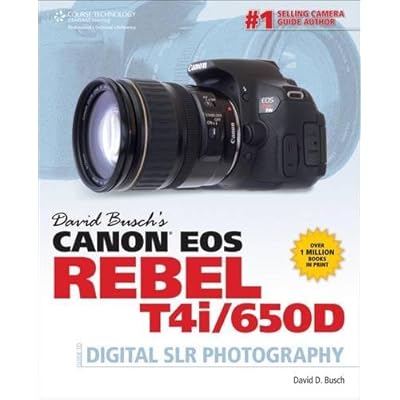
David Busch’s Canon EOS Rebel T4i/650D Guide to Digital SLR Photography (David Busch's Digital Photography Guides)
Category: Books,Arts & Photography,Photography & Video
David Busch’s Canon EOS Rebel T4i/650D Guide to Digital SLR Photography (David Busch's Digital Photography Guides) Details
From the Author The new Canon EOS Rebel T4i/650D shares some basic features with its predecessor, but actually represents a huge leap forward for Canon, starting with the easy-to-use touch-sensitive screen to an amazing new "Hybrid CMOS" sensor that allows this camera to combine fast phase detection focus with traditional contrast detection autofocus in movie and live view shooting modes. There are also new STM lenses that take advantage of the T4i/650D's improved AF features to provide fast and quiet AF. I'm pleased that I've been able to fill this 500-page book with the kind of information you won't find other guides for this sophisticated camera. Whether you're a veteran dSLR owner, a pro, an advanced amateur who is switching to the T4i, a budding enthusiast who wants to learn all of the camera's great features, or an ambitious beginner who wants to learn the basics of photography, sit down with me and we'll explore this camera together. You're in for a great ride!Everything in this book is devoted to helping you master your T4i/650D, with specific tips on using the camera. Here's what you'll find inside:Part I: Getting Started with Your Canon T4i. This section consists of three chapters that let you hit the ground running. There's an introduction to using the new touch screen to quickly navigate menus and make settings, and a quickie guide to selecting the T4i's exposure, autofocus, and other controls, so you can glean the important information you need immediately, and learn how to tweak your settings after you've taken some great pictures with your new camera. My unique Streetsmart Roadmap shows you what every component is, and how/when to use it, and includes nearly two-dozen large photographs and screen shots of the T4i so you can locate everything quickly.Part II: Mastering Your Tools. The four thick chapters in this Part tell you everything you need to know about exposure with the T4i, (including my dismantling of the myth of the 18 percent gray card), autofocus, HDR, and other tools. One full chapter is devoted to nailing the right exposure, every time. Another dissects the new AF system of the T4i, and explains how to take advantage of its features. There's an entire chapter on shooting movies, divided into sections on working with the T4i's movie features (such as Video Snapshots) accompanied by advice on how to improve your video with composition, lighting, and storytelling techniques. The fourth chapter in this part explains continuous shooting, time-lapse photography, and topics like geotagging.Part III: Configuring Your Canon EOS T4i/650D. Most guidebooks have a chapter near the front of the book that list all the menu options available, and what they do. Just like Canon's own manual, only with more words. Part III, two chapters that total nearly 100 pages, not only tell you when and why to use each of the dozens of shooting, custom, and setup options of your Canon T4i - but when not to use them.If you don't have access to the information in this section, you don't really know how to use your T4i.Part IV: Enhancing Your Canon EOS T4i. Your camera has such powerful features for working with light that I needed two chapters to explain it all. One chapter discusses basic flash features, while a second chapter is devoted exclusively to using the T4i's amazing wireless flash capabilities. The pricey -- but powerful -- new Speedlite 600EX-RT is included. If your interested in expanding your lens kit, you'll find one chapter that describes Canon's current lens line-up, and what they can do for you. Once the T4i-specifics are out of the way, I finish off the book with two chapters that describe your software options, and provide some trouble-shooting tips.Frankly, despite its low cost, the T4i is an advanced camera, so I didn't want to pad it with general-purpose chapters on, say, how to shoot landscapes, or how to shoot sports. Instead, I stuffed this hefty book with the kind of detailed tips and information you can use to take any kind of picture you want with the new features of the Canon EOS Rebel T4i/650D. Feel free to use the Look Inside! feature to explore the most comprehensive guidebook available for your camera. Read more About the Author With more than a million books in print, David D. Busch is the world's #1 selling digital camera guide author, and the originator of popular digital photography series like David Busch's Pro Secrets and David Busch's Quick Snap Guides. He has written more than a dozen hugely successful guidebooks for Canon and Canon digital SLR models, as well as many popular books devoted to dSLRs, including Mastering Digital SLR Photography, Second Edition, and Digital SLR Pro Secrets. As a roving photojournalist for more than twenty years, he illustrated his books, magazine articles, and newspaper reports with award-winning images. He's operated his own commercial studio, suffocated in formal dress while shooting weddings-for-hire, and shot sports for a daily newspaper and upstate New York college. His photos and articles have appeared in Popular Photography & Imaging, The Rangefinder, The Professional Photographer, and hundreds of other publications. He has also reviewed dozens of digital cameras for CNet and Computer Shopper, and his advice has been featured in National Public Radio's "All Tech Considered." When About.com named its top five books on Beginning Digital Photography, debuting at the #1 and #2 slots were Busch's Digital Photography All-In-One Desk Reference for Dummies and Mastering Digital Photography. During the past year, he's had as many as five of his books listed in the Top 20 of Amazon.com's Digital Photography Bestseller list--simultaneously! Busch's 120-plus other books published since 1983 include bestsellers like David Busch's Quick Snap Guide to Digital SLR Lenses. Visit his website at http://www.dslrguides.com. Read more


Reviews
This guide does exactly what it is supposed to. It shows you how to dig into the nitty gritty of the Canon T4i. It also goes a little farther by showing you some techniques that can be acheived with the T4i. I'm sure there are general books on DSLR photography that will give you the same info, but it seems like a bonus to me that the extra info is in this guide. One example is his explanation of focus stacking, which I'd never heard of. Another good tip I gleaned from this guide was how to correct the aberration on one of my lenses. The camera does all the work, but I would never have found the setting had it not been for this guide. Of course, that isn't all I've learned from this guide, but those things were very important to me.I'm not a first time reader of David Busch, in fact, this is my third book by him. One other guide (Canon XSi) and one on DSLR photography. I like his style, sense of humor, and his ability to make things a little more understandable. The Canon T4i can be as easy or complicated as you want it to be, and this guide makes it very enjoyable to learn either way. I highly recomend this book.EDIT: August 24, 2013After reading "The Most Helpful Negative Review" it got me to thinking "Did I just miss something?" Actually, at the time I wrote my review I was not the least bit interested in the video portion of this great camera, so I could have been biased to just imagee. Fortunately, all of the ins & outs of video concerning the T4i ARE covered in this book, so I don't totally understand how the OP of the negative review could have missed it. Granted, it is kind of spread out and not in just one Chapter like you might think, but it is all there somewhere, and a quick glance at the index will lead you to what you want to know.This is straight from the Table of Contents (and yes, I've read every word and it isn't generic, but for the T4i): Movies, pages 157-177, capturing; composition for; creative lighting; default settings; displaying movies only; DOF (depth of field) and; editing (in camera)160-162; estanblishing shots in; face detaction +tracking mode; FlexiZone-Milti Mode; FlexiZone-Single Mode; focus modes for; grid display for; Playback menu; image stabilitation for; judder when shooting; movie setting menues; playing back movies; resolution (this discuses all of the available resolutions available to you and how much memory they use). I could go on and on, this is only about about half of the subjects on shooting video WITH the T4i that's listed in the index. I'm not touting Mr. Busch's book in any way, I just like for people to be given straight up info. I truely depend on these reviews to purchase.