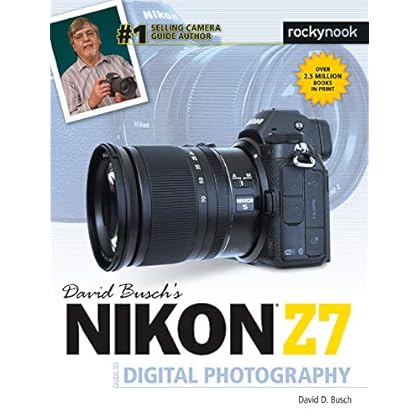
David Busch's Nikon Z7 Guide to Digital Photography (The David Busch Camera Guide Series)
Category: Books,Arts & Photography,Photography & Video
David Busch's Nikon Z7 Guide to Digital Photography (The David Busch Camera Guide Series) Details
From the Author If anyone tells you that the Nikon Z7 is just a Z6 with higher resolution, don't believe them! In writing books for both cameras, I was surprised at just how different they are. I uncovered more than a few undocumented -- or poorly documented -- features that one camera has and the other lacks, which is why I decided to write separate guides for each. Rest assured, despite the family resemblance, this book was written specifically for your Z7, and I've filled its pages with the many tips and techniques for the Z7 I've gathered since I've been using it extensively since September, 2019.Although I do slip in some technical details about things like the Z7's innovative BSI sensor and five-axis image stabilization, I didn't want my book to be top-heavy with technology. So, as I explain in detail how to use every feature and menu option, I try to relate everything to real-world shooting, offering you both background information and guidance that will help you put the Z7's exposure, AF, and optical capabilities to work. Even if you already know the basics, I think you'll learn something new as we explore this great camera together. Read more From the Inside Flap ·Table of Contents·Chapter 1·Thinking Outside the Box·Initial Setup·Mastering the Multi Selector and Command Dials·Setting the Clock·Battery Included·Final Steps·Chapter 2·Nikon Z7 Quick Start·Choosing a Release Mode·Selecting an Exposure Mode·Choosing a Metering Mode·Choosing a Focus Mode·Choosing the Focus Area Mode·Adjusting White Balance and ISO·Reviewing the Images You've Taken·Transferring Photos to Your Computer·Changing Default Settings·Resetting the Nikon Z7·Recommended Default Changes·Shooting Tips·Photo Shooting Menu Recommendations·Custom Setting Menu Recommendations·Chapter 3·Nikon Z7 Roadmap·The Nikon Z7's Business End·Playing Back Images·Zooming the Nikon Z7 Playback Display·Viewing Thumbnails·Using the Photo Data Displays·Going Topside·Lens Components·Underneath Your Nikon Z7·The Viewfinder/Monitor Displays·What's the Fuss about BSI?·Chapter 4·Nailing the Right Exposure·Getting a Handle on Exposure·Equivalent Exposure·How the Z7 Calculates Exposure·Metering Mid-Tones·Choosing a Metering Method·Matrix Metering·Center-weighted·Spot Metering·Highlight-Weighted Metering·Choosing an Exposure Method·Aperture-Priority·Shutter-Priority·Program Mode·Manual Exposure·Adjusting Exposure with ISO Settings·Dealing with Noise·Bracketing·White Balance Bracketing·ADL Bracketing·Working with HDR·Fixing Exposures with Histograms·Tonal Range·Histogram Basics·Understanding Histograms·Fine-Tuning Exposure·Chapter 5·Mastering the Mysteries of Focus·How Focus Works·Contrast Detection/Phase Detection·Adding Circles of Confusion·Using Autofocus with the Nikon Z7·Autofocus vs. Manual Focus·Autofocus Mode and Priority·Autofocus Mode·Choosing an Autofocus Area Mode·Face Detection and Subject Tracking·Face-Priority AF·Subject Tracking·Store by Orientation·Autofocus Activation... and More·Manual Focus·Split-Screen Display Zoom·Back Button Focus·Activating Back Button Focus·Fine-Tuning the Focus of Your Lenses·Lens Tune-up Options·Evaluating Current Focus·Changing the Fine-Tuning Setting·Setting the Default Value·Chapter 6·Advanced Techniques·Continuous Shooting ·Working with Short/Long Exposures·Delayed Exposures·Self-Timer·Interval/Time-Lapse Photography·Using Interval Photography·Time-Lapse Movies·Multiple Exposures·Geotagging with the Nikon GP-1a·Focus Shift Shooting·Trap (Auto) Focus·Using SnapBridge·Using the SnapBridge App·Chapter 7·Focus on Lenses·Choosing Native Z-mount Lenses·Nikkor Z 35mm f/1.8 S·Nikkor Z 50mm f/1.8 S·Nikkor Z 24-70mm f/4 S·Nikkor Z 58mm f/0.95 S Noct·Universal VR·Using the FTZ Adapter·Ingredients of Nikon's Alphanumeric Soup·Zoom or Prime?·Categories of Lenses·Using Wide-Angle and Wide-Zoom Lenses ·Using Telephoto and Tele-Zoom Lenses·Telephotos and Bokeh·Nikon's Lens Roundup·The Magic Three·Wide to Medium/Long Zooms·Telephoto and Normal Lenses·Macro/Specialized Lenses·Chapter 8·Mastering Light·Continuous Lighting Basics·Living with Color Temperature·Types of Light·Lighting Accessories·Chapter 9·Electronic Flash with the Nikon Z7·Electronic Flash Basics·A Tale of Two Exposures·Measuring Exposure·Guide Numbers·Choosing a Flash Sync Mode ·Ghost Images·High-Speed (FP) Sync·Using External Flash·Using Flash Exposure Compensation·Specifying Flash Shutter Speed·Previewing Your Flash Effect·Flash Control·Working with Nikon Flash External Units·Light Modifiers·Using Zoom Heads·Flash Modes·Repeating Flash·Chapter 10·Wireless and Multiple Flash·Elements of Wireless Flash·Master Flash·Remote Flashes·Channels, Groups, Lighting Ratios·Setting Your Master Flash Read more See all Editorial Reviews


Reviews
I found this book very understandable and helpful. I've written tech books myself, so know how hard it is to get such a book out with high quality quickly, but only found one error in the entire book, a trivial reference to using SD cards the Z7 can't support, rather than XQD cards it can at Loc 8757. I particularly enjoyed reading it on the new 12.9" iPad Pro, which does a wonderful job of showing off the many very helpful photos included in the book, and can follow its URL links.Busch has intentionally aimed this book at both folks who've used DSLRs or MILCs for years and newbies aiming for the top with their first MILC. In this, he succeeded well, not boring me (a 5 year MILC user) with repetition, while also adding quite a lot to my knowledge of both the Z7 I've used now for 3 months and digital photography in general. For instance, I found its multi-page section on using histograms well both very clear and very useful.One of my favorite parts was the later chapters on settable options. I really appreciated that the author didn't just tell me the possible settings, nor even just which settings he prefers, but also explains why and under what circumstances he prefers the settings he recommends.The only weakness I noted in the book is that it mentions the U1, U2 and U3 user settings, but doesn't give any really practical examples of exactly how to use them, nor point out why one might not want to use them.I'm not very interested in video myself, but the last two chapters do a fine job not just of explaining how to do video on the Z7, and why it is so great for that task, but also provide a tutorial on how to get good audio and video from any such camera.Overall, this book is everything I hoped it would be, and well worth its cost. I'll be referring to it often for years to come. Definitely recommended!