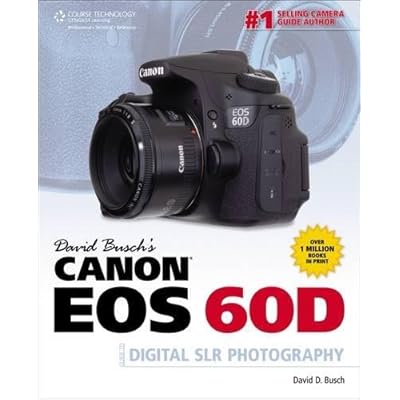
David Busch's Canon EOS 60D Guide to Digital SLR Photography (David Busch's Digital Photography Guides)
Category: Books,Arts & Photography,Photography & Video
David Busch's Canon EOS 60D Guide to Digital SLR Photography (David Busch's Digital Photography Guides) Details
From the Author In depth, yet accessible, for beginners and Canon veteransRather than rush to be first on the shelves with a cursory overview of the Canon EOS 60D, I decided to take some extra time putting together this comprehensive, 400-page guide that answers all the questions that both beginners and more experienced amateurs will have about this sophisticated camera. If you're serious about photography, you need:Detailed coverage of the 60D's autofocus features. Are you confused by all the 60D's autofocus options? Learn how to choose focus modes and zone selection methods to snap into sharp focus every time. You'll find explanations of exactly how phase detection and contrast detection work, and step-by-step instructions for using techniques like stack focus. Essential advice on settings options. You need more than just a rehash of menu options and settings. You want advice on when you should use (or not use) each option. I've included two full chapters (more than 100 pages) of tips so you can set up your camera with confidence.A full chapter on shooting movies and Live View. My tips go beyond just the camera controls to show you how to get better movies and audio using storyboards, establishing shots, close-ups, two-shots, and more. Get the most from your 60D's full HD video capabilities.First-hand experience with the full array of Canon lenses for the 60D. I own and use virtually every lens in the Canon line, and have summarized my recommendations on a full chapter that evaluates the available lenses.The latest technology. I'm always looking at new stuff, like Eye-Fi cards, GPS, and smartphone/tablet apps, and provide the latest news in my books.Entire chapters on exposure and histograms, flash and other topics. Improve your photography skills as you learn to use your 60D.I know you'll enjoy using your new 60D as much as I have. Sit down with me and let me show you how to get the most from your camera. And if you need a camera-bag-friendly guide to take with you everywhere, I have written a Compact Field Guide for this camera, too. Read more About the Author With more than a million books in print, David D. Busch is the world's #1 selling digital camera guide author, and the originator of popular digital photography series like David Busch's Pro Secrets and David Busch's Quick Snap Guides. He has written more than a dozen hugely successful guidebooks for Canon and Canon digital SLR models, as well as many popular books devoted to dSLRs, including Mastering Digital SLR Photography, Second Edition, and Digital SLR Pro Secrets. As a roving photojournalist for more than twenty years, he illustrated his books, magazine articles, and newspaper reports with award-winning images. He's operated his own commercial studio, suffocated in formal dress while shooting weddings-for-hire, and shot sports for a daily newspaper and upstate New York college. His photos and articles have appeared in Popular Photography & Imaging, The Rangefinder, The Professional Photographer, and hundreds of other publications. He has also reviewed dozens of digital cameras for CNet and Computer Shopper, and his advice has been featured in National Public Radio's "All Tech Considered." When About.com named its top five books on Beginning Digital Photography, debuting at the #1 and #2 slots were Busch's Digital Photography All-In-One Desk Reference for Dummies and Mastering Digital Photography. During the past year, he's had as many as five of his books listed in the Top 20 of Amazon.com's Digital Photography Bestseller list--simultaneously! Busch's 120-plus other books published since 1983 include bestsellers like David Busch's Quick Snap Guide to Digital SLR Lenses. Visit his website at http://www.dslrguides.com. Read more


Reviews
The David Busch books are highly regarded and recommended in the camera community for beginners and enthusiasts alike. As cameras get more complicated it's great to have a guide that walks you through all the camera options, and ways to quickly access them and customize your menus. In that regard this book scores fairly high points.For beginners there is the quick start guide, chapters on the ins and outs of creative mode settings, types of AF, live view, picture styles, flash photography, how to get images off of your camera, and editing your image.There are many visual examples of the camera and its functions. There are step by step walkthroughs of all the menus, and ways to customize your favorite items to your own personal menu system. There are extensive descriptions of live shooting and screen setups. Different exposure settings, uses and examples are well explained; from speed to aperture to ISO, along with metering modes. There is a section for off camera flash(es), synchronization and controlling a slave and groups. Step by step details of all the custom functions under camera set-up. The list goes on and on, and there's a lot to be had here. Everything is outlined in a fairly entertaining and concise way.For serious enthusiasts or experts, it's much more of a mixed bag. There's a lot you already know here. Things like a listing of the EF-S lenses or flashes. Shooting through blinds for dramatic portraits (!?). Picture styles and filters. I think most experts have a firm grasp of most of the above if it's relevant to them, making almost half of the book a pass. This is not really too much of a problem for me really either. The book tries to be all things to all people I suppose, and some of it was a bit of a refresher course. But more of it was a course on basic photography than I had thought it would be.My larger concern is what appears to be poor editing. This could pose a bit of confusion for beginners if this is your first DSLR camera, and even folks like me who have half a clue! This probably comes from the fact that most of the book was taken from his guide for the 7D. While I have seen some of the mistakes pointed out - such as the claim the 60D has a metal body, these are not stand-outs in my opinion. What are however are some explanations which in turn are supported by visual examples, which are either wrong or mislabeled. Additionally, there are references to features that exist only on the 7D, which clearly should have been omitted when "porting" this book over to the 60D.I'll throw out just two examples of many. When describing bracketing for exposure, two photo examples for shadow and highlight exposure are juxtaposed. This could leave a beginning shooter scratching their head. Another time in the Live View chapter he mentions that grids are also available in viewfinder mode "Hey really? I didn't know that, cool!". There is then a reference to the chapter and section in the set-up menu where you won't find it. Grids aren't available in viewfinder mode on the 60D. Yeah David, ya had me going there.These misgivings aside, this is still a great guide to the 60D. It is an excellent book for those starting out with DSLR's, as it covers every aspect of what is needed to get the most out of your camera, from putting the batteries in to getting images out. There are descriptions of focal length, DOF, and even pitfalls of wide angle lenses.Personally now that I've gone through it, I probably would have been better off with the compact field guide. For the most part I know what I want to find out, and need a way to access the information quickly. You won't get that here. The obvious advantages to this book are the way it's organized for fist timers, basic photography methods along with the blow by blow description of all the features and ways to access them. Things I would hope to find are missing; such as more in depth examples and uses of different types A-F, like back button A-F.So I give it 4 stars if you're new to the world of DSLR's, but probably about 3 stars for serious enthusiasts. For me about a 3.5.