The Prisons / Le Carceri (Dover Fine Art, History of Art)
Category: Books,Arts & Photography,Individual Artists
The Prisons / Le Carceri (Dover Fine Art, History of Art) Details
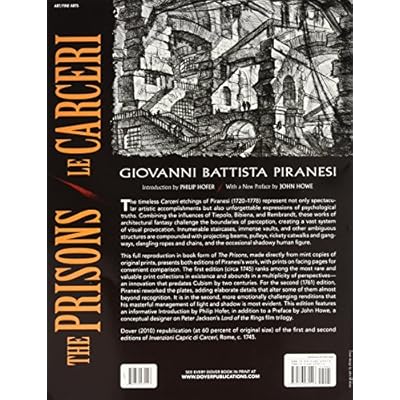
The timeless Carceri etchings of Piranesi (1720–1778) represent not only spectacular artistic accomplishments but also unforgettable expressions of psychological truths. Combining the influences of Tiepolo, Bibiena, and Rembrandt, these works of architectural fantasy challenge the boundaries of perception, creating a vast system of visual provocation. Innumerable staircases, immense vaults, and other ambiguous structures are compounded with projecting beams, pulleys, rickety catwalks and gangways, dangling ropes and chains, and the occasional shadowy human figure.This full reproduction in book form of The Prisons, made directly from mint copies of original prints, presents both editions of Piranesi's work, with prints on facing pages for convenient comparison. The first edition (circa 1745) ranks among the most rare and valuable print collections in existence and abounds in a multiplicity of perspectives—an innovation that predates Cubism by two centuries. For the second (1761) edition, Piranesi reworked the plates, adding elaborate details that alter some of them almost beyond recognition. It is in the second, more emotionally challenging renditions that his masterful management of light and shadow is most evident. This edition features an informative Introduction by Philip Hofer, in addition to a Preface by John Howe, a conceptual designer on Peter Jackson's Lord of the Rings film trilogy.



Reviews
I was vaguely aware of Piranesi and his etchings of Roman ruins and imaginary prisons, but it was only upon recently reading Marguerite Yourcenar's essay, "The Dark Brain of Piranesi", that I felt the compulsion to closely study "The Prisons", or, in Piranesi's Italian, "Le Carceri". This Dover edition is an ideal vehicle for doing so.Piranesi made two editions of his prison etchings. The first, released about 1745, contained fourteen prints. For the second, in 1761, Piranesi reworked those fourteen etchings and added two entirely new ones. The reworked etchings are much darker and more detailed, making for a darker nightmare altogether. For the fourteen prints of which there are two states, this Dover edition presents them side by side, so that the viewer can easily study the revisions that Piranesi made. The two new plates from the second edition are also included. The original etchings were approximately 16 by 21 inches. Here, they are printed at 60 per cent of their original size. The prints used for this Dover book were mint condition prints from the National Gallery of Art, with the result that the Dover book is excellent (I can't speak to the Kindle version) and at $16.95 it is a true value in the world of fine art books.Piranesi's prison etchings depict the interior of a vast edifice, which seems to expand out to the deep visual recesses of each plate somewhat like the expanding universe. Never is there a window or door to the outside. The structures are many-tiered, with massive vaults and columns, grand staircases and narrow winding stairways, and many bridges cutting across the immense interior space. As depicted, the prisons are physical impossibilities from the standpoint of the rules of perspective as well as the laws of physics. In the second edition plates, there are wheels, pulleys, cranes, winches, and capstans, all imparting a brooding sense of torture. Small, indistinct humanoid figures are scattered throughout the prisons.The overall impression I have is of humankind imprisoned by its own creations and technologies. Marguerite Yourcenar says that "Le Carceri", along with Goya's "Black Paintings", "are one of the most secret works bequeathed to us by a man of the eighteenth century." Further, "the Prisons may well be one of the first and most mysterious symptoms of that obsession with torture and incarceration which increasingly possesses men's minds during the last decades of the eighteenth century" . . . an anticipation, perhaps, "of Sade and the excesses of the Revolution."For me, it was bewitching to spend half an hour perusing THE PRISONS / LE CARCERI. But it was a one-off exercise, something like my experience with the drawings of M. C. Escher. I doubt that I will ever return to the book. In that sense, for me "Le Carceri" takes a back seat to Goya's "Black Paintings".[Addendum, 11 Jan. 2018: I just learned that Goya and Piranesi may have shared lodgings in Rome around 1770 -- a tantalizing coincidence, if true.]