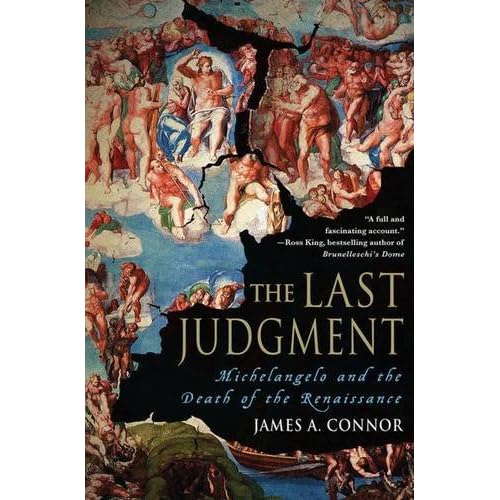
The Last Judgment: Michelangelo and the Death of the Renaissance
Category: Books,New, Used & Rental Textbooks,Humanities
The Last Judgment: Michelangelo and the Death of the Renaissance Details
From Publishers Weekly Michelangelo did not want to create the Last Judgment (1537–1541), yet, argues Connor (Pascal's Wager), it was his clearest expression of the terror at the bottom of his psyche, a terror stemming largely from the conflict between his probable homosexual desires and his religious faith. Connor traces the creation of the Last Judgment and Michelangelo's struggle to reconcile his innate religious zeal with his love for nobleman Tommaso de Cavalieri. Connor's narrative is compelling, his writing vivid and evocative. An English professor and former Jesuit priest, he superbly places the Last Judgment in the context of Copernicus's heliocentric universe and of the Catholic reforms of Savonarola and the Council of Trent. Yet the Council condemned the work for its nudity and unconventional portraits of religious figures; a chapter on the fresco's censorship is one of the book's most fascinating. The monumental painting was ultimately driven less by Michelangelo's artistic impulses than by his desire for salvation. Connor presents an indispensable perspective for the general reader as well as fresh insights for the specialist. (July) Copyright © Reed Business Information, a division of Reed Elsevier Inc. All rights reserved. Read more Review “Connor's narrative is compelling, his writing vivid and evocative. [...] An indispensable perspective for the general reader as well as fresh insights for the specialist.” ―Publishers Weekly“Connor gives a full and fascinating account of the history and personalities involved in the creation of one of the world's most forbidding and beautiful frescoes. The Last Judgment is also readable and succinct, and it offers intriguing insights into a culture hastening towards its own destruction.” ―Ross King, bestselling author of Brunelleschi's Dome and Michelangelo and the Pope's Ceiling“James Connor clarifies the dizzying Renaissance swirl of science, politics, art and war with language as vivid and colorful as a newly cleaned fresco.” ―Mary Doria Russell, bestselling author of The Sparrow and A Thread of Grace“The 17th century was a rough, bloody time in which ignorance, corruption, and religious hatred often trumped knowledge, ethical behavior, and religious tolerance...By showing Kepler's inability to shield his own mother, Connor drives this point forcibly home.” ―The Los Angeles Times on Kepler's Witch“A compelling and readable study of one of the most influential thinkers in religious history.” ―Booklist on Pascal's Wager Read more See all Editorial Reviews


Reviews
"In planning his design, Michaelangelo understood that the primary beholder for his fresco would be the pope and not the public at large. Therefore, he set the structure of the fresco so that its proper viewing points would correspond with the places that the pope would inhabit the chapel." pg. 86Dr. Connor's excellent scholarship and research offer the reader a unique vantage point to view this somewhat puzzling, confounding, but acknowledged masterpiece, along with the personalities involved. The writing is superb. Fresh and original points made in this book are finely supported so that the novice and the expert may comfortably find it very readable. The examination of the fresco should be of interest to historians, historians of religion and of art. The chapter on the fresco's censorship (pg. 185) is exceptionally interesting. This book should be used as a supplement in the study of this important work of art.Dr. Connor's book on the art, politics, and science of the renaissance has been a very clarifying read. I highly recommend it.